
Tree Planting Online in India: What Really Happens After You Pay
Yes, you can plant a tree online, but not in the way the phrase sounds. Nobody plants a sapling through a screen. What you do online is pay for a real sapling to be planted and looked after by a field team, then follow its progress from wherever you are.
That is how tree planting online works in India, and it is why the quality of the programme matters more than the quality of the website. This guide explains the steps, what you should receive, the questions that separate a real planting from a vague promise, and what it costs.
What Tree Planting Online Actually Means
When a platform says you can plant a tree online, it means you are funding the work. You choose a project, you pay, and the organisation's team does the physical planting on land it has arranged. The online part is the booking, the certificate and the tracking.
There are no virtual trees in this model. A sapling goes into soil somewhere, and your payment covers that sapling, the land work around it and, in good programmes, the care it needs afterwards. So the useful question is not whether it is possible. It is whether the organisation can show you where your sapling is and who looks after it.
How Tree Planting Online Works in India, Step by Step
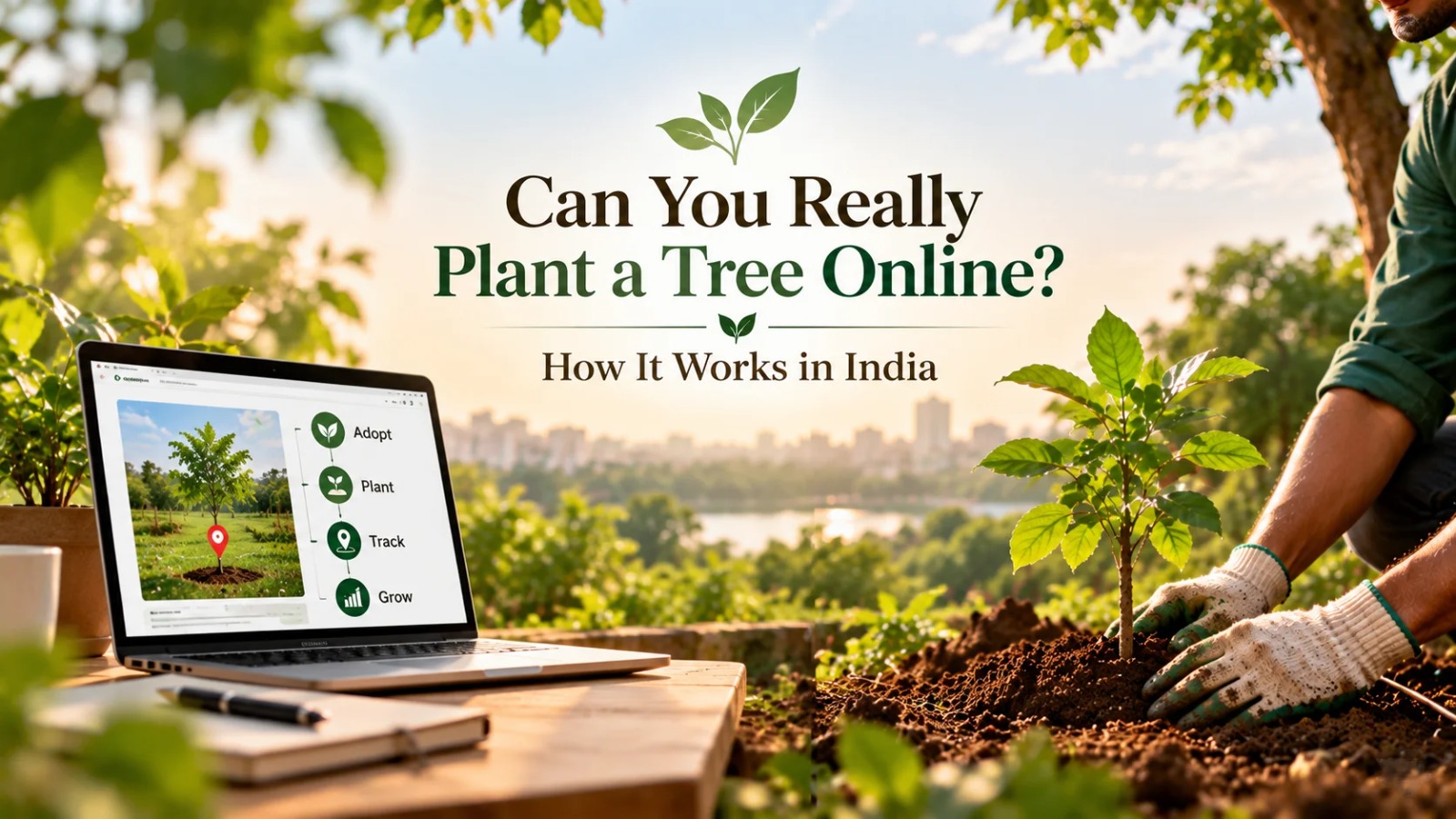
The process is similar across platforms, though the details differ:
• Choose a project. Platforms list planting sites with a location, a species mix and a price per sapling.
• Pay online. You can usually adopt for yourself or in someone else's name as a gift.
• The team prepares the land. At our site this means excavating the soil bed, adding manure and marking each pit.
• The sapling is planted. A field team plants a native sapling suited to the local climate.
• You receive proof. This can be a digital certificate, a photo and, at better programmes, the sapling's coordinates.
• The sapling is looked after. Watering, mulching, monitoring and replacement if it fails decide whether it survives.
• You follow the updates. Photos and progress notes show how it is growing.
Steps three and six are the ones most people never see. They are also where most of the cost and most of the risk sit.
What You Pay For
The price covers more than a sapling. At Catch Your Tree, ₹586 covers three years of care, and our adoption page publishes the split: maintenance takes 55%, land preparation 37%, plantation and support 4%, the sapling itself 3% and technology 1%.
Public listings on other Indian platforms run from ₹85 to ₹1,850 per sapling, depending on the project. The gap comes mostly from the species planted, the location and how long the care lasts. A low price is not a flaw in itself, but you should know what it includes before you compare.
Why Verification Matters
Planting on someone else's behalf asks you to trust a report you cannot easily check. It helps to know that the gap between reported and real results is a documented problem in India. A national audit of the Green India Mission found inflated data and overstated achievements built on non-validated files, and satellite analysis showed that 70 percent of sampled sites had no noticeable change attributable to the mission.
That audit covered a government scheme, not online platforms. Still, it shows why you should ask for proof that does not rest on the organisation's own word.
How to Check a Tree Planting Online Offer
Ask these questions of any organisation, ours included:
• Where is the sapling planted? Look for a named site, not only a state or the words "across India".
• Is each sapling individually located? Coordinates for your sapling are stronger proof than a general photo of a plantation.
• How long is it looked after, and by whom? A planting with no care period behind it is a planting that may not survive.
• What happens if it dies? Replacement should be part of the price.
• Are the species native to the site? Native species need less water and survive better.
• Are the updates specific and dated? Stock images and vague progress notes are a warning sign.
• Is the organisation registered and established? Check for NGO registration and a record longer than one campaign.
• Can you visit? An organisation that welcomes a site visit has little to hide.
An organisation that welcomes these questions is easier to trust. One that dodges them should make you cautious.
What a Good Update Looks Like
Updates are how you check that the planting happened, so it helps to know what a good one contains. A good update shows the actual site, carries a date and says which stage the work has reached. It tells you which species were planted and how your sapling is doing. At better programmes it points to your sapling's own location rather than a general photo of a plantation.
A weak update is a stock image, a generic line such as "your tree is growing well", or nothing at all for months. If you cannot tell whether an update relates to your sapling, ask for something more specific. Our own tracking runs through FITS, the Forest Impact Tracking System, and every adoption includes a geo-tagged location you can look up.
Common Misunderstandings About Online Planting
It is not a virtual tree. The sapling is real and the work is physical. Only the booking and tracking happen on a screen.
A certificate is not proof by itself. It shows you paid. What proves the planting is a location you can check, updates you can date and, ideally, a visit.
Cheaper is not always worse, and dearer is not always better. The right question is what the price covers, and for how long.
Online Planting vs Planting It Yourself
Planting a sapling yourself gives you control and a hands-on experience. It also needs land, the right season and a plan for watering through the first dry seasons. Many saplings planted on a whim die because nobody follows up.
Tree planting online suits situations where you cannot do that. You may live in a flat, live far from your family, or want a gift for someone in another city. Timing is the other difference. Saplings generally settle in best with the monsoon rains, so a birthday or anniversary in peak summer is a hard moment to plant on your own. With an online adoption, the planting follows the project's own schedule, so you do not have to line it up with the weather. Many people do both: plant a small sapling at home and adopt a tree online so that at least one is cared for properly.
How the Models Differ
Online tree planting comes in several models. Some platforms plant fruit trees on farms and community land, where farmers and rural communities benefit from the fruit. Others, like ours, plant native forest species in dense groups on prepared land. Some track every sapling individually, and others report by project. None of these is wrong, but they serve different goals, so pick the one that matches what you want from it.
Who Tree Planting Online Suits
• People in flats or rented homes who have no space to plant.
• People living away from family who want to mark a birthday or anniversary with something that keeps growing.
• Companies, schools and housing societies planning CSR or community events.
• Anyone joining a national campaign from a distance. Ek Ped Maa Ke Naam asks people to plant a sapling in their mother's name, and online adoption lets you do that even when you are in a different city.
Tree Planting Online for Companies, Schools and Societies
Tree planting online is not only for individuals. Companies, schools and housing societies adopt in bulk for CSR, sustainability goals and employee engagement, and many choose to plant trees online because it removes the logistics. The same checks apply, with one addition: ask what reporting you will receive and how it is verified, because a CSR report is only as strong as the evidence behind it. For bulk adoption, talk to our team.
Does Planting a Tree Online Actually Help?
One sapling is a small contribution, and it is fair to say so. India's total forest and tree cover stands at 25.17 percent of its land area, and closing the gap to the national target takes millions of saplings that survive. What one adoption does is add a sapling that is looked after for three years and can be checked, which is the part that tends to go missing at scale. Tree planting online helps when the sapling lives, and it lives when someone waters it. That is why the care period matters more than the planting day.
What You Get When You Plant a Tree Online With Us
When you adopt a tree through Catch Your Tree, you receive:
• A digital certificate with the details of your adoption
• The geo-tagged location of your sapling
• Photo updates as it grows
• Tracking through FITS, our Forest Impact Tracking System
• Three years of watering, mulching, monitoring and replacement if needed
Adoptions are currently planted at Ashok Chakra Van in Ahmedabad, Gujarat, working toward 30,000 trees. You can read more on our Ahmedabad project page. After three years, a sapling is expected to be self-sufficient and keep growing for decades. CATCH Foundation reports survival above 90% across its forests. The cost is ₹586 per sapling, and you can start on our adoption page.
The Tax Benefit
CATCH Foundation is registered under the Public Trust Act, 1950, with 12A and 80G status, and our adoption page describes contributions as eligible for a deduction under Section 80G. Whether you can claim it depends on your tax regime and the rules in force when you file, so check with a tax adviser. This is general information and not tax advice.
Who Is Behind Catch Your Tree
Catch Your Tree is run by CATCH Foundation, which began in 2014 as a cleanliness drive in one Ahmedabad housing society and has since planted over 12.8 lakh trees across 30 cities. You can read the full story on our About Us page.
Frequently Asked Questions
Can you really plant a tree online?
Yes, in the sense that you fund a real sapling that a field team plants and looks after. You do not plant it yourself, and nothing is virtual. The online part is the booking, the certificate and the tracking.
How does tree planting online work in India?
You choose a project and pay online. The organisation prepares the land, plants a sapling and looks after it. You receive proof such as a certificate, a location and photo updates, then follow its growth.
Is it safe to plant a tree online?
It is as safe as the organisation behind it. Check that it names a planting site, gives your sapling a location, states how long it cares for it and is a registered NGO with a track record.
How do I know my tree was actually planted?
Look for individual coordinates, dated photo updates and an offer to visit the site. A certificate alone only shows that you paid.
How much does it cost to plant a tree online in India?
At Catch Your Tree it costs ₹586 per sapling and covers three years of care. Other platforms list prices from ₹85 to ₹1,850, depending on the project.
Can I visit the place where my sapling is planted?
Ask the organisation before you pay. At Catch Your Tree you can contact us to ask about visiting the planting site.
Can I plant a tree online as a gift?
Yes. You can adopt in someone else's name, and the certificate is issued for them along with the location and updates.
Is planting a tree online tax-deductible?
CATCH Foundation has 12A and 80G registration, and contributions are described as eligible under Section 80G. Whether you can claim a deduction depends on your tax regime, so check with a tax adviser.
Plant a Tree Online and Follow It for Three Years
Planting online works when you can see what happened to your money. If you want to try tree planting online with a sapling you can locate, you can adopt a tree and receive your certificate and its exact location.


